**Choosing the Right Custom Flags for Events and Business Promotion**

Outdoor branding does not always need a large billboard or permanent sign. Sometimes, a well-positioned flag can communicate a business name, event message, or promotional offer while taking up relatively little ground space.
[Custom flags printing](https://zamadina.com/flags-printing-dubai/) are particularly useful because they combine visibility with flexibility. They can be placed outside shops, around event entrances, beside exhibition stands, near property developments, or along temporary promotional areas. However, not every flag format is suited to every situation.
The right choice depends on where the flag will be placed, how far away people will see it, how often it needs to be moved, and what kind of visual impression the business wants to create.
**Start With the Purpose of the Flag**
Before choosing a shape or size, identify what the flag needs to accomplish.
A business may want a flag to:
**Identify a storefront
Direct visitors toward an entrance
Promote a limited-time offer
Mark an exhibition stand
Add branding to an outdoor event
Improve visibility from a road
Create a consistent look across a venue
Support a product launch or property opening**
These goals can require very different solutions.
For example, an exhibition stand may benefit from a lightweight flag that can be assembled quickly, while a permanent outdoor location may require a heavier base and a more substantial structure.
A useful starting point is this complete guide to choosing custom flags for events and business promotion, which covers different flag categories and their potential applications.
**Consider Where People Will See It**
Viewing distance has a major influence on flag design.
A flag placed beside a shop entrance may be viewed from only a few metres away. A flag positioned near a roadside location may need to communicate its message from considerably farther away.
This affects:
**Flag height
Letter size
Logo size
Colour contrast
Amount of text
Overall shape**
For outdoor advertising, a simple message is generally easier to understand than a design filled with small details. The business name, logo, or main message should be immediately noticeable, while supporting information can remain secondary.
**L-Shape Flags for Clear, Structured Displays**
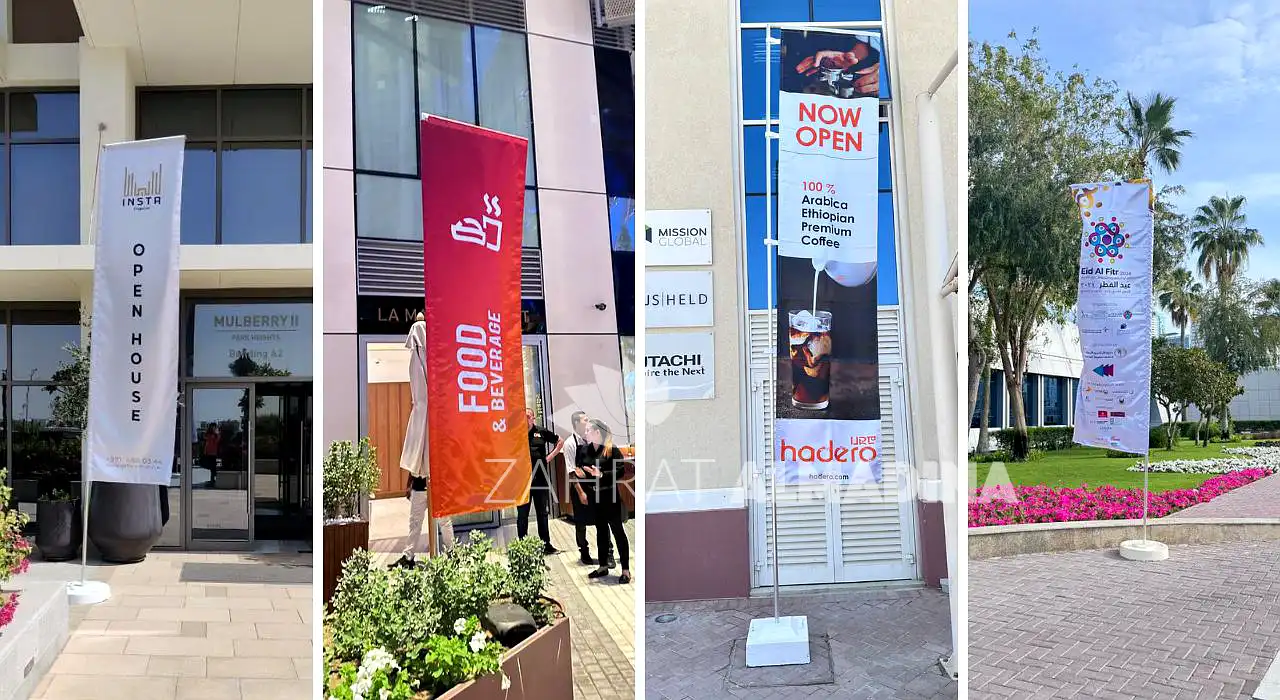
L-shape flags use a horizontal arm at the top of the pole to hold the fabric open. This means the printed area can remain visible even when there is little airflow.
This format can work well where a business wants a relatively structured presentation. Storefronts, commercial entrances, event spaces, and roadside locations are examples where the format may be useful.
The shape also gives designers a predictable print area. Important branding elements can be positioned without relying on wind to open the fabric.
For businesses comparing [L-shape flags for outdoor branding](https://zamadina.com/flags-printing-dubai/l-shape-flags/), the main consideration should be whether the structured profile fits the available space and the intended viewing direction.
**Sail Flags for a More Distinctive Profile**
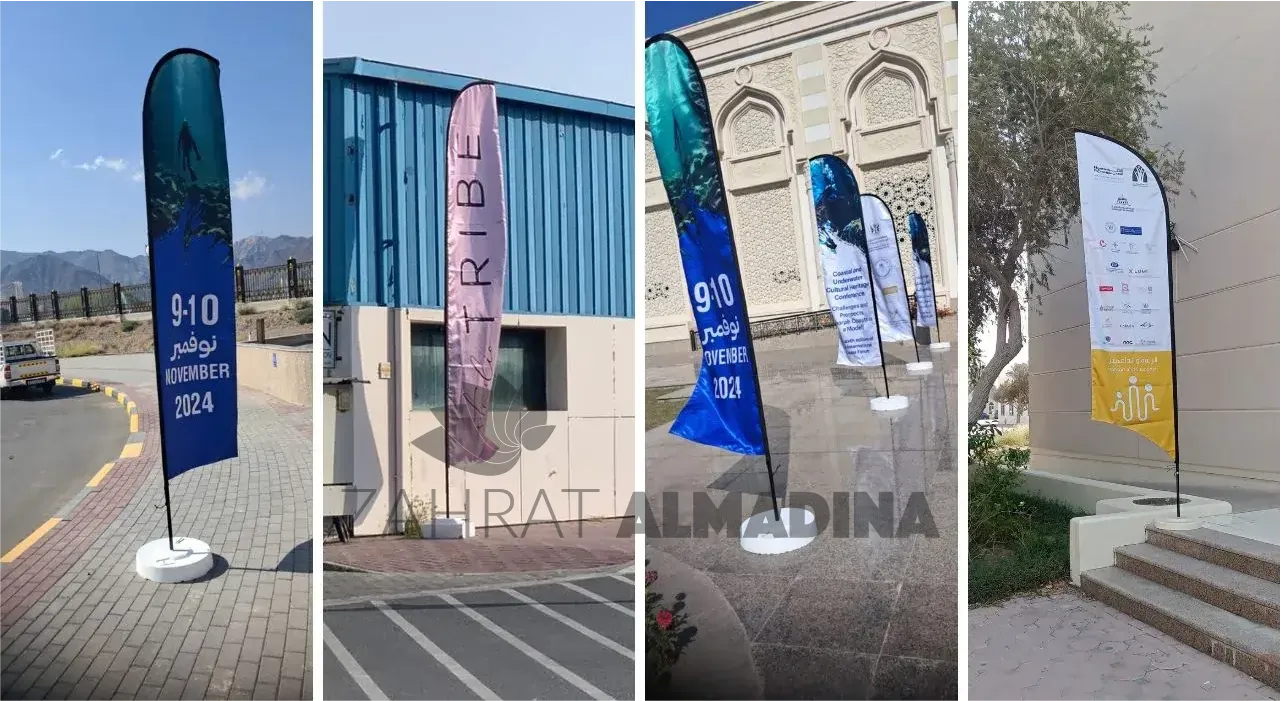
[Sail flags](https://zamadina.com/flags-printing-dubai/sail-flags/) have a curved pole at the top that keeps the fabric stretched into a tall, flowing profile. The bottom of the flag can also have different shapes, creating variations in the overall silhouette.
This makes them suitable for businesses that want something more visually distinctive than a conventional rectangular display.
They can be used around:
**Hotel entrances
Retail stores
Real estate developments
Corporate events
Exhibition areas
Outdoor promotional spaces**
The curved profile can also create a stronger sense of movement, making sail flags useful when the visual design is intended to feel energetic rather than formal.

**Feather Flags for Events and Promotions**
Feather flags have a tall, curved profile and are commonly used for retail promotions, exhibitions, sporting events, restaurants, and outdoor campaigns. Their lightweight construction makes them practical for businesses that need to set up and reuse displays in different locations.
They are particularly useful when the goal is to create repeated branding around a venue.
For example, an event organiser could position several matching [Custom feather flags](https://zamadina.com/flags-printing-dubai/feather-flags/) along an entrance route. A retailer might use one outside the storefront to highlight a promotion.
The main advantage is not simply the height. It is the combination of a relatively small footprint with a visible vertical graphic.
**Teardrop Flags for Strong Visual Recognition**
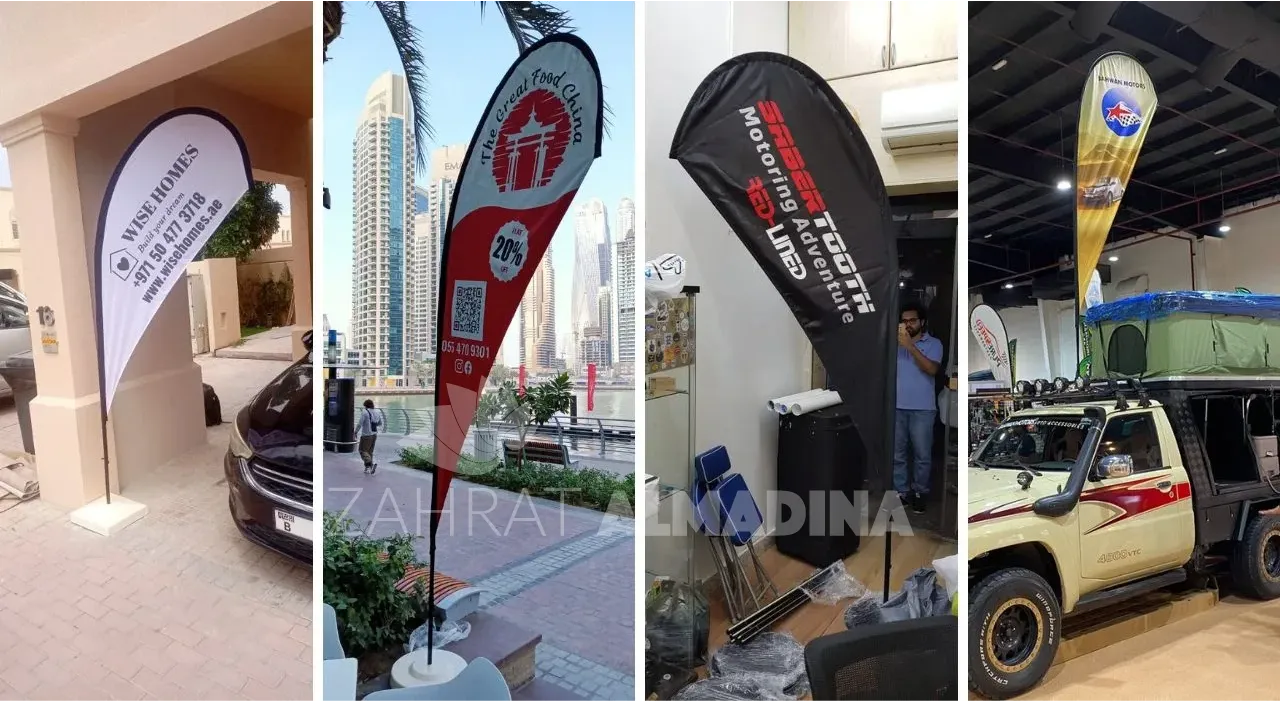
Teardrop flags have a distinctive shape that is widest toward the top and narrows toward a rounded point at the bottom. This gives them a recognisable silhouette that differs from feather and sail formats.
They can work well at:
**Exhibition entrances
Retail locations
Roadside businesses
Outdoor events
Real estate launches
Hospitality venues**
The shape naturally draws attention toward the upper section of the flag, so logos and short headlines can be positioned where they are easiest to notice.
When choosing [teardrop displays for high-visibility outdoor areas](https://zamadina.com/flags-printing-dubai/teardrop-flags/), businesses should also consider the available base, wind conditions, and the amount of space around the flag.
**Telescopic Flags for Flexible Setups**
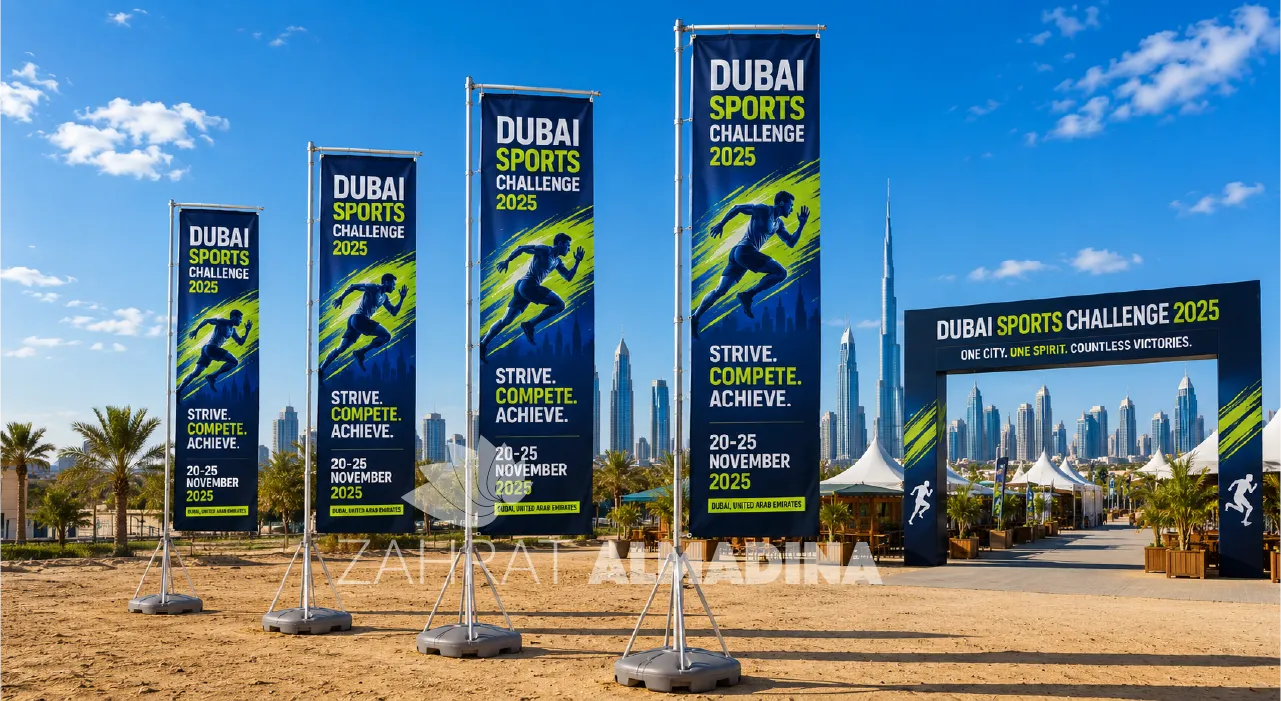
Some businesses need displays that can be moved between different environments. [Best Telescopic flags](https://zamadina.com/flags-printing-dubai/telescopic-flags/) are designed around an adjustable pole, allowing the height to be changed depending on the location. The available systems can extend up to around five metres.
This can be useful for companies that participate in multiple events or run promotional campaigns at different locations.
For example, a business might use a lower setting at an indoor event and extend the pole further for an outdoor promotion.
This flexibility can reduce the need for completely different display systems when the same branding needs to be used in several environments.
**Keep the Design Simple**
Choosing the right flag structure is only part of the process. The printed design also needs to work at a distance.
A common mistake is trying to include too much information.
A flag might contain:
**Logo
Business name
Short message
Website
Promotional offer**
But including every service, social media account, phone number, and long slogan can make the design difficult to read.
A simpler layout usually works better for a moving audience. Visitors should be able to understand the primary message within a few seconds.
**Select the Base According to the Location**
The flag itself is only one part of the display. The base needs to match the environment.
Indoor exhibition areas may allow for smaller or lighter bases. Outdoor spaces can require heavier solutions, particularly where wind exposure is higher.
Before ordering, consider whether the flag will be placed on:
**Concrete
Paved ground
Grass
Sand
Indoor flooring
A temporary event surface**
The location, expected weather, and duration of use should all be considered before selecting the support system.
**Think About Reuse**
If a business plans to use a flag for only one event, the design may be campaign-specific. But if the display will be reused, it is often better to create a design that remains relevant over a longer period.
For example, a company could use its core logo and brand colours rather than a message tied to one particular promotion.
Reusable displays can be particularly practical for businesses attending several exhibitions, seasonal events, or promotional campaigns throughout the year.
**Match the Flag to the Brand Environment**
A flag should complement its surroundings rather than compete with everything around it.
A corporate office may require a more restrained design. A children's event could use brighter graphics and more playful shapes. A real estate launch might use a coordinated series of flags to create a branded route from the entrance to the sales centre.
There is no single format that works for every business.
The strongest choice is usually the one that fits the location, audience, message, and practical requirements at the same time.
**Plan a Consistent Flag Display**
Using several flags can create a stronger visual system than placing unrelated designs throughout a venue.
A coordinated display might use the same:
**Logo placement
Colour palette
Typography
Graphic style
Message hierarchy**
Different flag shapes can still be combined if the overall branding remains consistent.
For example, an event might use sail flags near the main entrance, feather flags around activity areas, and teardrop flags beside individual exhibition zones.
The different formats can perform different functions while still looking like part of the same event.
**Final Thoughts**
Choosing custom flags is not simply a matter of picking the most noticeable shape. The decision should consider the location, viewing distance, message, portability, base requirements, expected weather, and how often the display will be reused.
L-shape flags can provide a structured presentation, sail flags offer a distinctive curved profile, feather flags work well for flexible promotional displays, teardrop flags provide a recognisable silhouette, and telescopic systems can offer adjustable height for changing environments.
When the format and design are matched to the actual purpose, a simple flag can become a practical part of an event or business's visual identity without overwhelming the space around it.